Saturday, 22 October 2011

     Is it really this long since I blogged?? Yes, it certainly is, and the reason is that I have been learning a new occupation - loom assembly and teaching weaving on the Hattersley single width loom! Now, at my advanced age, the acquisition of new skills cannot be taken lightly and my lack of talent in the direction of multi-tasking meant that while I was finding my feet, so to speak, the blog had to sit on the back burner like a dye-pot building up a good colour.
     I'm not saying I'm the world's best teacher, because I'm not. But it's very satisfying to see my two students progressing nicely. After four weeks of the twelve week course, we have studied the basics - drafting, tie-in and peddling. Then of course mistake rectification, a bit of design work with the point paper and now we're getting onto multiple colours and multiple shuttles. All exciting stuff. They have had one session on my warping mill and hopefully the part-warp languishing there will be finished during the coming week.

     The training project has been organised by Harris Development Ltd and funded by various bodies including Leader and the Heritage Lottery Fund. In tandem, a training course for double-width weavers is being run in Harris too and these weavers are destined to supply the mills, whereas my weavers will be setting up in business as independent weavers designing and weaving for their own markets. All very exciting.

     The loom building was, and continues to be, a real challenge. Though my own weaving course at Lews Castle College in 1994 included loom assembly and adjustment, that was a long time ago and it has been a bit of a steep learning curve aided and supported by my other and, some would say, better half!

     For fellow bloggers who like this sort of thing - and I know there are one or two or you lurking - I've got some detailed photos of loom parts for you. Now, settle down there at the back......


 This is the back part of the card reader assembly and shows the cam on the right which controls the hex card box and the slide cam which is fitted onto the low shaft and operates the levers which are connected to the hooks that turn the box back and forth.


Here's a back view, looking towards the revolving box and showing the top shaft fly wheel, the left hand picking stick with its brackets, the warp bar at the back and a back view of board 4.


Diving underneath the loom at the back, here's a good view of the tappets though they are a little furry from the linen warp I was weaving at the time.  Tappets control the boards and from this angle and reading from left to right, there are two plain weave tappets not in use, then 2-up-2-downs for boards 1,2,3 and 4 and then another 2 plain weave tappets on the right.  The toothed wheel on the right connects with the adjustable toothed collar on the shaft and this is how the shed timing is adjusted.


Here's a useful view of the top shaft pointing to the back of the loom and you can see the bottom cam pointing towards the front of the loom and the roller on the picking stick about 10 cm away from the join in the cam.  This is a good guide for timing the picking.  On the other side, the cam is pointing the other way and the roller is just a couple of centimetres away from the join.


The revolving box showing the bracing underneath which supports the extra weight of the mark 2 box and also a birds eye view of the box brakes.


The card reader in the foreground in its open state showing the fingers above waiting to descend into the card on the next shot thus telling the box which way to turn on the shot after that.


Close up of the revolving box showing the proximity of the horseshoe to the brass end of the box and also the gap between the end of the race board and the horseshoe.  Note also the trip plate at the back above the beginning of the race board which acts as a soft landing should the shuttle get caught at the entrance of the box.


Possibly my favourite piece of the loom - the take-up.  Toothed wheels elegantly fit and work together to operate the prickly roller which pulls forward the finished cloth to the required number of shots per inch.  The small toothed wheel is the shot wheel - note the jubilee clip between the shot wheel and the split pin at the end - this makes an ideal replacement if you lose the big nut that is supposed to go there.  Also, the right hand toothed wheel is the one which is changed if you need to weave larger numbers of shots to the inch.  For Harris Tweed it is customary to have this wheel fitted and the shot wheel moves forward to teeth at a time - thus a 36 tooth wheel puts in 18 shots per inch.  For using all the teeth on the shot wheel a smaller toothed wheel is fitted and a tubular hook fitted to the going part  is adjusted to reduce the number of teeth taken up.


Finally, here's a shot of the pirn winder showing the bottom rail which holds the spindle bases.  To adapt a mark 1 pirn winder to take mark 2 pirns the bottom rail needs to be raised.

That's enough of that now.  Today the rain is very heavy and very wet, but we have had one or two nice days.  The rams are getting ready to be loosed for tupping at the beginning of November and all the hens are moulting, so no fresh eggs for breakfast!

Thursday, 8 September 2011

Still Dyeing!

Having finished my first jumbo bobbin of Shetland singles for my proposed Handspun Harris Tweed - it turned out at 1417m and weighed 350g and then I was ready to dye it. Using Omega dyes this time which are really straightforward.  I have also bought a little scale to measure out the dyes, and it's very useful.


3g of Sun gold dissolved and mixed into the simmering water. A quarter of the hank submerged and left for 20mins then rinsed and spun in a horizontal spin drier.


Then 5.5g Turquoise dye dumped in on top of the yellow (too mean to boil up more hot water!)


This gave a lovely light green.  Then 7g Flame.


 And finally weighed out the last dye - 5g medium blue.

And here is the last quarter hank soaking and simmering....


Then the hank was washed in liquid soap (courtesy of Hebridean Soap Ltd), rinsed with a little white vinegar, and spun till it was nearly dry.  Of course I forgot to take a picture of the hank when it was finished!


Above is the hank wound onto a cone.  Interestingly, it measured 1380m and weighed 349g on this occasion.  So this worked out to be around a 9 cut.

For the next hank, I had run out of Flame dye so substituted wine red.  Again dyed in the same order so the yellow and green (turquoise) are the same as the first hank, but the wine red came out a rich Christmassy colour (if you know what I mean) and this in turn reacted with the medium blue to make a vivid purple.
It is just fascinating to see what happens isn't it!
Next hank - which will not be very soon as I have a lot of work on just now - I'm going to put in a substitute for the turquoise.  Haven't decided what to put in its place yet, any suggestions??
If you are wondering what all this is going to look like when it's woven up, then I'm afraid you'll have to wait and see, because I haven't a clue either!!

Busy this week assembling Hattersley looms for the forthcoming weaver training course; warping up another grey Hobbit linen while I have the 3 ends to a dent reed in and threaded up;  finishing off some gorgeous mohair for Sallie at Driftwater Weaves; starting picking black Wensleydale for rasta yarn which will be off to Tracy at Gedgrave Wensleydales in Suffolk when it's finished; and carding up Daisy the cross Cheviot's fleece from last year which I thought would look nice as a rug to take with me to the Uist Wool Group Michaelmas Event in Grimsay on 24th September.

In between times, the Cheviot ram is continuing his Golden Hoof treatment for footrot, which seems to be working well, the Hebridean sheep keep breaking out of their field and running riot around the neighbouring crofts (they are supposed to be confined until the end of September), and Tilly the cat has been catching mice like the true trooper she is!

Saturday, 20 August 2011

Catch Up Time

What a long time it's been since I last posted.  Things have been even more hectic than usual. 
Meantime, I went to an amazing workshop at An Lanntair - our local arts centre in Stornoway.  The workshop was called "Design in Tweed" and it involved handlooms, lots of different colours of yarns, CAD and also learning the proper way to write down weaving patterns. 


There were seven of us on the course and there were two two day courses held that week, both were fully subscribed.  Our trainer was Sam Goates (http://www.weareonecreative.com/) who has masses of experience in the textile industry as a designer and weaver and has an enthusiasm for her subject which is positively viral!


For me it has opened up a new world of trying out patterns on paper, saving up for CAD software for myself and meeting a new network of contacts.  Thank you Sam, hope it won't be too long before we see you back for some more workshops.


We've also had the South Harris Agricultural Show since my last blog, which was a great event.  The sun shone, the midgies were away picnicking elsewhere, and the show was well populated with attractions and those enjoying their day out.  Above is a picture of one of the regular attractions - the Drakes of Hazard (http://www.drakesofhazard.co.uk/).  These are a group of Indian Runner ducks who are guided through an obstacle course by very talented and entertaining sheepdogs.  Their wrangler, Mark Wylie, provides a hilarious commentary and there is opportunity for audience participation too.


Another amazing attraction was Ben Potter who was displaying his Birds of Prey (http://www.birdsofpreydisplays.co.uk/).   He has several different birds which he introduces and then they fly free over the arena.  The bird pictured above is a sea eagle, and it made a truly magnificent spectacle as it swooped in over the loch at Leverburgh.  Though we do have sea eagles here in Harris and have seen them at a distance, this was the first time most of us had seen one close up.  Not a bird to get on the wrong side of methinks!


Back to the loomshed after our day out, and finishing off a hand-spinning order for a local company.  This was a lovely cheviot ram who turned out to be a bit more kempy than I originally thought, but the yarn has a great character, and I hope I have produced something that will weave nicely in the Hattersley loom.  It's also been great to get some practice for our own hand-spun harris tweed which will be lurching into existence within the next few months.  The picture shows the hank of hand-spun being wound onto a cone on the Munty.
For those interested, I have discovered that for handspun yarn, the Hattersley is happiest with around a 12 or 12.5 Gala cut count.  Hands up who doesn't know what Gala cut is?  Well historically it is the yarn count used for Harris Tweed, though I think maybe it is being superseded by Nm to bring it into line with other textiles.  Anyway, 1 cut gala means that 200 yards will weigh 1 pound. Not metric I'm afraid, which will immediately alienate all readers under 40 years of age! However, with the aid of a calculator, it's not rocket science to convert it all into metres and grammes if you wish.  The easiest way to find the count of handspun is to measure its length, then weigh it as accurately as possible.  Divide metres into grams and this will mean you can work out the Nm, Tex or whatever you wish. 
For the 12 cut gala you are looking for around 4.8 metres per gram.  the average Ashford jumbo bobbin will take around 300 g of 12 cut and this will measure about 1.5 km.  The longer the length you have to measure, the more accurate the average count will be.


Here's one of my new linens - a thick and thin weft one woven on the very smallest shot wheel I have.  The thick linen is from Jos Vanneste in Belgium and is soft and smooth - almost like the fibres haven't yet been spun.  We find they need a good close warp to keep it all together, but once it's done and washed, it gives a gorgous almost boucle effect, very 1960's little Jackie O suits.


Introducing son of Mr Four-Horn, caught on camera in the distance.  He is coming on well and we have high hopes of him both in the horn and breeding departments.


And finally, Tilly the cat has found a roost in the loomshed.  I knew the warping mill would come in useful!


Wednesday, 20 July 2011

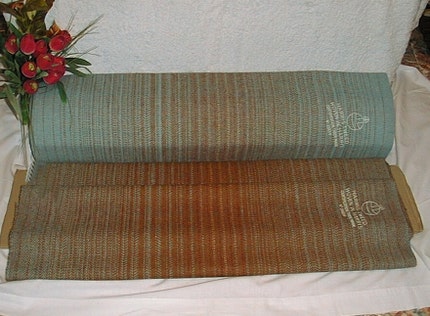
Scalpay Linen Harris Tweed on Stage at the Hebridean Celtic Festival

We are blessed this week at Scalpay Linen - some of our special Harris Tweed was included in a fabulous outfit designed by Netty Sopata of "Diggory Brown" and worn by K T Tunstall.  The orange and brown tweed was ours, and the black came from our friends at Breanish Tweed in Lewis.  And the fabby photo was taken by Leila Angus of Brighter Still.


On the blog we followed this tweed through from warp to finished -


The brown element of the warp is from the yarn kindly spun for me by Harris Tweed Hebrides in Shawbost last year and is made of local Hebridean fleeces. 

Agricultural Shows coming up:  this coming Saturday maybe see you at the Lochs Show which will be at their new showground in Laxay this year.  I'm judging the poultry competitions, so I've been knee-deep in the encylopaedia of chickens for the past few days genning up.... 

Then next Tuesday the South Harris Show is at Leverburgh and we will be entering some chickens for that one.  Drakes of Hazzared will be there again I believe - always great fun, as well as Chainsaw Pete and various other attractions.  Check out their website for full details:  http://www.south-harris-show.com/index.html

Thursday, 14 July 2011

Some Sad New

Every so often we lose a good friend on the croft and so it is with sadness that we announce that our senior Hebridean ram passed away yesterday evening surrounded by friends and family.


He will be much missed by us all though he leaves a multitude of offspring here in Scalpay and also in Galson and Ammhunsuidhe where he enjoyed working holidays during his long and productive life.  He has a son - one of last years' lambs who is showing great promise on the horn front both in numbers and also in shape - who will be taking on Mr Four-Horns' duties from now.

Thursday, 30 June 2011

Buth Scalpaigh news, Koolaid Dyeing, new linen cloth, Tuppy loses his coat and cats & dogs...

Great news - the share issue for our local community shop - Buth Scalpaigh has not only reached, but completely demolished the target sum!  Today is the last day to join so as to get an invitation to the first shareholders meeting, but shares will still be on sale to anyone who wishes to contribute in the future.
We are now all champing at the bit waiting for the refurbishments to begin.  I think a celebration is going to take place during the summer, so watch this space and if you are in the area, come along and enjoy with us.

Settle down class - I know it's nearly the summer holidays, but today we are going to learn dyeing with Kool-Aid.  Anyone who has done it before, please sit quietly at the back and get on with your spinning....

First of all, you need a pyrex measuring jug (1 litre capacity) and a heatproof pyrex bowl, some tongs and some rubber gloves (to protect your hands from staining), and of course a hank of wool to dye.  Koolaid only works on wool, so don't try to be clever with using other fibres.  Put the kettle on to boil. If you wish you can pre-wet the hank, or if, like me, you like a really tweedy uneven look to your dyeing, just use it dry.  If there is a bit of oil in the wool it will resist the dye, and some of it will take it up quicker than others.  If you are after a really perfect and professional finish then you really shouldn't be using Kool-Aid and a microwave!


Open the first packet of Kool-Aid and empty it into the measuring jug.


When the kettle boils, top up the jug with boiling water (scalding hazard!!) and stir to dissolve the powder.

Put part of your prepared hank into the bowl and pour the jug of colour over it.  Pop into the microwave for one minute on full and then remove carefully (with oven gloves because the bowl is hot).
Lift the hank from the bowl and marvel at the fact that all the colour has migrated from the water into the wool......

Wring out carefully and prepare the next bowl of dye -  you can use the same water, just top it up with fresh boiling water as required.


Repeat in the microwave and then do it again with a third pack of Kool-Aid.


At the end of dyeing, wash the hank carefully in whatever you usually use - soap, detergent etc. and spin the excess water out.
Hang up to dry and admire your handiwork....

Kool-Aid is relatively light-fast, but don't expect too much as it is, after all, only a soft-drink powder.  The yarn I used was a merino hand-spun from fibre bought from Wingham Woolworks, with a bamboo binder, that didn't take up the dye and retained its lovely shiny appearance.

New on the loom - a pink linen of the same ilk as the grey one and the most recent denim-look.  We are really getting into the swing with these cloths and they are coming out beautifully.

Here is one of the denims - very textured so it has to be hand-finished.
Looks gorgeous against the light and even though I've only got a few samples finished, it is already being snapped up by some discerning visitors.
Look out for more of these in different colours from us later on.


The Hand-spun Harris Tweed is progressing.  Have done some sample spinning of the Zwartbles for weft, and now Tuppy the Shetland ram who came to us from Sallie at Driftwater Weaves in Tobson, Great Bernera, has donated his coat to use in the warp.
We also have some amazing grey Shetland which we swopped last year for some of our Hebridean fleeces, and are also looking forward to the first shear cheviots that have been promised from Borve in South Harris.  This project is going to take a long time, but already is proving to be such fun.  Some of my visitors are contributing ideas and suggestions, which are all very gratefully received.  Doespins (see last post comments) has boosted my morale with her helpful comments on using handspun for warp.  The warp patterning is going to be very complicated and I haven't yet found my way into where to start designing, but there is still so much spinning to do that there is no rush to get it done.

And finally, a mega-cute pic of Bramble and Tilly the cat enjoying a relaxing moment on the sofa!


Tilly is getting very good at galloping through the loomshed and ending up on the loom, bouncing on the warp at the back.  When you pick her up, every last little claw is hooked round a warp end and its like she's playing the harp!  She's a little cutie though, and we love having her around.

Friday, 17 June 2011

Where did the time go??

I didn't realise that it has been such a long time since last posting on the blog.  Many apologies to my faithful readers.  Excuses coming up........  Well....  my laptop was fried by lightning and I had to get another one, and get it up and running with all the bits and pieces of software etc.; the local broadband folks were on a go slow, and Vodafone dongles were on an even slower go-slow which meant they were almost stationery!; then we had a few days out - attended a royal visit at the Bays Centre at Leac 'a lee (great cafe, and marvellous place to see seals); been to the dentist - now I'm really scraping the barrel.  We've also been magnificently busy in the shed - t-towels flying off the shelves (and not with the gale force winds!) and lots and lots of weaving being done.
As promised a couple of blogs ago, below is a pic of the dyeing I did a while ago using the handspun Falkland and Shropshire wools which I made up chunkyish and used a glossy viscose binder to stabilise it for handknitting.  These were omega dyes, and they worked out very well, though my skill in measuring out granules to get the correct colour is still very hit and miss.


Also in the picture on the far right is a super fluffy mohair hank that is destined for Sallie at Driftwater Weaves in Gt Bernera.

The postie brought a lovely surprise from Beth in the US who was a spinning  member of the "Singing Weavers" party in May and who promised to send me some Koolaid for dyeing.  Good as her word, they arrived safely and I can't wait to start using them.  Thank you so much Beth, I am seeking out a very special little something to send in return..

Despite the very changeable weather, summer is creeping up on us slowly I guess.  I have a huge predatory plant in my little shed-garden.  It appeared from the dregs of some bird seed I dumped there at the end of last year and is now sporting some dangerous looking spikey leaves and thistley heads.  I don't know what it is exactly but have the feeling that it could be carniverous - and should I be careful going to the shed at night? 


Newest and smallest member of the croft family - introducing little Tilly.  She has come to us from Shawbost in Lewis and is around 10 weeks old.  Already the three dogs are under the prickly paw and she is quite relaxed about her new position as queen of the croft.

To show that I have been working too, here is the latest fleece from the Gedgrave Wensleydales in Suffolk which we are spinning up for Tracey.  This one is short, but incredibly soft.  The individual locks were just a tad too short, and separate to spin normally, so I popped the whole thing through the carder just once to keep lots of curly bits, but open it up a bit to make spinning more straightforward.  This is the carded fleece.  It's spun up a treat - some plain and some with multi-coloured silk. 

And finally, two big bags of Zwartbles fleeces arrived from Hampshire last week.  Gorgeous and thank you Caroline.  They are so black with coppery tips, and so crimpy, and so oily!  We are planning our piece de resistance - which is going to be a Handspun Harris Tweed - and are trying to decide what breeds to use.  We think the Zwartbles is going to be one - below is some of the fleece which I have washed in preparation for carding and then doing some experimental spinning.  Though I've done loads of spinning for weaving in the past, I've never done any warps - always been put off by the received wisdom that its a real pain to get it twisted enough to stay together as it goes through the eyes.  So there is going to be quite a bit of R & D before this project gets off the ground!


News of the community shop - share issue going very well and shares can now be purchased via Paypal direct from the shop website (see links on right).  To be part of the fun, just click on the link......