Saturday, 21 January 2012

Appeal

     Is there anybody out there who has a female Angora Goat surplus to requirements?  A friend has just lost hers and her billy goat is lonely and sad as a result.  If anyone can help, please let me know and I'll pass your details on. 

Friday, 20 January 2012

     At last, I have got my Haldane spinning wheel back on its hooves and it's working again.  Yes, the drive band is a bit of cotton band and the shade isn't really in keeping with the rest of it, but I stuck the legs on with wood glue, put a bent tack in the crank on the shaft and it seems to be going really well now.
     The reason behind all this refurbishment is that I've finally come to the conclusion that it's not possible to get a really tight twist on the jumbo bobbin of the Ashford - the ratios are all wrong!  So to get my handspun suitable for warps I need to get back to the Haldane. 
      I bought this wheel new in 1981 from a store in Highbury, North London and it has treadled miles for me.  When my daughter was small I worked as a commercial handspinner from home and though in recent years it has been rather left on the shelf (so to speak) mainly because of the falling legs syndrome, I'm so glad I never got rid of it.  Some years ago I bought new bobbins that had bearings as the original wooden ones were badly worn, and the flier is starting to get very grooved where the yarn rubs over it.  Wish they were still making these wheels - it's the best one I've ever had.

On the table of the wheel are a couple of bobbins of Zwartbles I've spun up to put in my cache towards the Handspun Harris Tweed. From two trips through the drum carder it will spin up to around an 8 cut Gala which should weave a good hefty tweed unlike anything else that's on the market just now.
     A new accessory in the loomshed (below) is this dinky little silicone brush which cost me £1.80 from Lewis Crofters Ltd in Stornoway.  Think its meant for brushing stuff over food, but is's great for cleaning keyboards, and also the hard to get at corners of the loom.  It picks up the odd dog or cat hair from the upholstery, and is so useful that I think I might need to buy another!
    

     Just so you know I've been doing some work recently, here is a tub of Wensleydale fleece in soak.  One hour in hand-hot water with 100ml of Hebridean Soap (Lemon and Eucalyptus) then a spin in a horizontal spin drier, another soak for 30 mins with a bit less soap this time, another spin, and finally a rinse for 10 mins in hand-hot water with 100mls of white vinegar to get the soap out.

     And the result is a gorgeous tub of white and goldern, fluffy locks which I can't wait to get started on when its nice and dry.  This fleece is destined for Teos Handspuns in Broadford, Isle of Skye.
     And finally, here's Tilly taking a rest from hunting.  We haven't seen many mice round since Tilly arrived, but Scalpay seems to be developing a rat problem!  Is this because now the North American Mink have almost been eradicated from the area, it's left a vacant niche for the rats to move in?  We caught one in our byre a couple of weeks ago, and there have been quite a few reported sightings and catchings elsewhere.  Nature never leaves a vacuum!  Keep going Tilly, we need you!

Wednesday, 14 December 2011

Some more linen designs

Spurred on by the arrival of my consignment fromJos Vanneste, I spent quite a long time sitting looking at it and wondering what to do with it!  So, building on my last lot of lacy linen, this new one is a step forward - the sley involves some crammed dents and some dents with only one end in them, the shotting is very wide and in a dark brown 16lea linen I got originally from Herdmans some years ago.The general effect on the front of the loom is a bit scary!  The draft is a staggered herringbone - 92 ends twill followed by 8 ends of herringbone.  The choice of this draft was because I don't know what the warp is going to do in the finishing.  If it all moves over, I'd rather it stopped against the herringbone instead of cramming up down one side.  Of course, I could be wrong  - I probably am.... but it's good fun seeing what's going to happen!

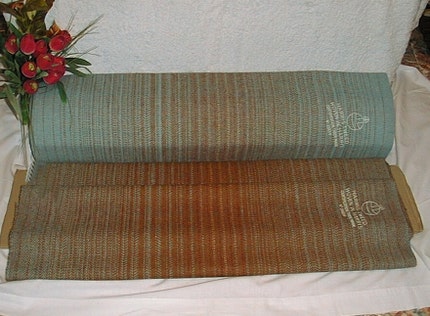
I started with the lovely autumnal orangey shade and, because it has to be hand-finished after weaving, I warped up 43 metres (which on a Nm6 took almost the whole 5kg) and am going to weave it in 10m lengths.  From experience I know that, even with arms as long as mine, anything in excess of 10m becomes a fiasco!  Here's a pic of the loom-state cloth.  Very stiff and net like.  This afternoon I'm going to cut off the first 10m, hem and finish, so look out for the finished cloth.  This picture is a bit strange as it doesn't look orangey at all - guess it must be the artificial light - it hasn't got properly daylight here for what seems like days.


Is there anything in this world more wonderful than a great big armful of Wensleydale wool?  If there is, then pleasedo  let me know!  The fibre arrived as a huge batt off a commercial carder and it was just amazing to spin - really quick and smooth. I plied two ends together to make something a bit like a commercial DK but much softer.  Guess it'll have to go back to Tracy at Gedgrave Wensleydales (see link on right), but I'm hoping to hang onto a few hanks, dye them and use them as the woollen element of some linsey-woolsey wraps for her.


In the loomshed just now we are finishing off the orange lacy linen, warping up another of the same but in a warm speckled wine shade, washing and hanking some rasta Wensleydale (another lot for Gedgrave), and looking out some spinning to do for Teo of www.teoshandspuns.com of Broadford, Isle of Skye.

The weather has been truly horrid over the past few weeks with hardly a dry wind-free day.  The croft has gone muddy, the sheep are getting used to a diet of hay again, and the Aylesbury ducks seem to have gone a dirty grey colour.  The only cheerful soul is No-name Turkey who is looking relaxed as she knows that she will live to see another Christmas.....

Thursday, 24 November 2011

Bad Weather Forecast, so time to catch up....

With a really bad forecast on for the rest of the afternoon and tonight, what better way to pass the time than update my blog, which yet again has been sadly neglected over the past month.

Yesterday was the annual Christmas Show and Sale at the Auction Mart in Stornoway.  As always a fine array of cattle and sheep were on top form and the crowds turned out, and the catering was up to scratch with teas, coffees, pies, sausage rolls and filled rolls to keep out the cold and stop the tummy rumbling.
It's good to see the selection of breeds getting larger - quite a change from 20 years ago when you were thought of as a bit racy if you had a cheviot ram tucked away on the croft!


When we arrived back home yesterday, there was a lovely surprise waiting for me - my linen yarn from NV Jos Vanneste had arrived.  The speed of post has been truly amazing - I paid on Thursday, it was posted in Belgium on Friday and arrived on Scalpay on Wednesday. 
These yarns are just amazing.  They come from the "Laura" range, which is a sort of melangey, marly type of effect with a bit of a texture going on.  I have used the Nm 12 extensively for the Hobbit order, but have now decided to change to Nm6 - principally because the finer yarn has to be sleyed at 3 to a dent and therefore is 940 ends wide, whereas the Nm 6 can go 2 to a dent with the same settings as Harris Tweed (maybe just a bigger shot wheel depending on the thickness of the weft being used).  The array of colours available in this quality is very wide, and it was difficult choosing a selection of shades for samples.  This yarn is the most expensive of any I currently weave with (excepting the hand-spuns of course), so this cloth is going to be top of my range.


A week or two ago I received a newsletter from Sollas Bookbinding.  Regular readers may remember that Corinna Krauss made me some gorgeous waxed paper covered boxes for presenting Hebridean Harris Tweed wraps, and I've been itching to spend more on her delightful products.
So when I looked through her online shop and found these elegant visitor books available, I couldn't resist treating the workshop to one for Christmas and Corinna added gold lettering for me too.  Visit www.sollasbooks.com for lots of gift ideas - you won't be disappointed!

Just to show that I have been doing something useful during the past month, a local company has asked for some samples of handspun to use, so Tracy from Gedgrave Wensleydales (see links on right) very kindly said I could use some of the  beautiful batt she sent up a while ago.  It has come out very elegantly - soft and around a 10 cut. Since I took this photo I dyed the yarn a really nice maroony, purply colour.  It was supposed to be red, but I have never professed to be a good, or accurate, dyer!  I've also spun up some greasy Zwartbles which is waiting to be washed, and a bit more of the Wensleydale white.  Hopefully it will be in the post sometime next week..


On the loom just now - more grey Hobbit linen.  The warping mill is empty waiting for one of the trainees to warp up for a celtic hopsack - this warp will involve turning the mini-reed behind the heck to produce a double-width mirror image pattern.  All exciting stuff.....

Saturday, 22 October 2011

     Is it really this long since I blogged?? Yes, it certainly is, and the reason is that I have been learning a new occupation - loom assembly and teaching weaving on the Hattersley single width loom! Now, at my advanced age, the acquisition of new skills cannot be taken lightly and my lack of talent in the direction of multi-tasking meant that while I was finding my feet, so to speak, the blog had to sit on the back burner like a dye-pot building up a good colour.
     I'm not saying I'm the world's best teacher, because I'm not. But it's very satisfying to see my two students progressing nicely. After four weeks of the twelve week course, we have studied the basics - drafting, tie-in and peddling. Then of course mistake rectification, a bit of design work with the point paper and now we're getting onto multiple colours and multiple shuttles. All exciting stuff. They have had one session on my warping mill and hopefully the part-warp languishing there will be finished during the coming week.

     The training project has been organised by Harris Development Ltd and funded by various bodies including Leader and the Heritage Lottery Fund. In tandem, a training course for double-width weavers is being run in Harris too and these weavers are destined to supply the mills, whereas my weavers will be setting up in business as independent weavers designing and weaving for their own markets. All very exciting.

     The loom building was, and continues to be, a real challenge. Though my own weaving course at Lews Castle College in 1994 included loom assembly and adjustment, that was a long time ago and it has been a bit of a steep learning curve aided and supported by my other and, some would say, better half!

     For fellow bloggers who like this sort of thing - and I know there are one or two or you lurking - I've got some detailed photos of loom parts for you. Now, settle down there at the back......


 This is the back part of the card reader assembly and shows the cam on the right which controls the hex card box and the slide cam which is fitted onto the low shaft and operates the levers which are connected to the hooks that turn the box back and forth.


Here's a back view, looking towards the revolving box and showing the top shaft fly wheel, the left hand picking stick with its brackets, the warp bar at the back and a back view of board 4.


Diving underneath the loom at the back, here's a good view of the tappets though they are a little furry from the linen warp I was weaving at the time.  Tappets control the boards and from this angle and reading from left to right, there are two plain weave tappets not in use, then 2-up-2-downs for boards 1,2,3 and 4 and then another 2 plain weave tappets on the right.  The toothed wheel on the right connects with the adjustable toothed collar on the shaft and this is how the shed timing is adjusted.


Here's a useful view of the top shaft pointing to the back of the loom and you can see the bottom cam pointing towards the front of the loom and the roller on the picking stick about 10 cm away from the join in the cam.  This is a good guide for timing the picking.  On the other side, the cam is pointing the other way and the roller is just a couple of centimetres away from the join.


The revolving box showing the bracing underneath which supports the extra weight of the mark 2 box and also a birds eye view of the box brakes.


The card reader in the foreground in its open state showing the fingers above waiting to descend into the card on the next shot thus telling the box which way to turn on the shot after that.


Close up of the revolving box showing the proximity of the horseshoe to the brass end of the box and also the gap between the end of the race board and the horseshoe.  Note also the trip plate at the back above the beginning of the race board which acts as a soft landing should the shuttle get caught at the entrance of the box.


Possibly my favourite piece of the loom - the take-up.  Toothed wheels elegantly fit and work together to operate the prickly roller which pulls forward the finished cloth to the required number of shots per inch.  The small toothed wheel is the shot wheel - note the jubilee clip between the shot wheel and the split pin at the end - this makes an ideal replacement if you lose the big nut that is supposed to go there.  Also, the right hand toothed wheel is the one which is changed if you need to weave larger numbers of shots to the inch.  For Harris Tweed it is customary to have this wheel fitted and the shot wheel moves forward to teeth at a time - thus a 36 tooth wheel puts in 18 shots per inch.  For using all the teeth on the shot wheel a smaller toothed wheel is fitted and a tubular hook fitted to the going part  is adjusted to reduce the number of teeth taken up.


Finally, here's a shot of the pirn winder showing the bottom rail which holds the spindle bases.  To adapt a mark 1 pirn winder to take mark 2 pirns the bottom rail needs to be raised.

That's enough of that now.  Today the rain is very heavy and very wet, but we have had one or two nice days.  The rams are getting ready to be loosed for tupping at the beginning of November and all the hens are moulting, so no fresh eggs for breakfast!

Thursday, 8 September 2011

Still Dyeing!

Having finished my first jumbo bobbin of Shetland singles for my proposed Handspun Harris Tweed - it turned out at 1417m and weighed 350g and then I was ready to dye it. Using Omega dyes this time which are really straightforward.  I have also bought a little scale to measure out the dyes, and it's very useful.


3g of Sun gold dissolved and mixed into the simmering water. A quarter of the hank submerged and left for 20mins then rinsed and spun in a horizontal spin drier.


Then 5.5g Turquoise dye dumped in on top of the yellow (too mean to boil up more hot water!)


This gave a lovely light green.  Then 7g Flame.


 And finally weighed out the last dye - 5g medium blue.

And here is the last quarter hank soaking and simmering....


Then the hank was washed in liquid soap (courtesy of Hebridean Soap Ltd), rinsed with a little white vinegar, and spun till it was nearly dry.  Of course I forgot to take a picture of the hank when it was finished!


Above is the hank wound onto a cone.  Interestingly, it measured 1380m and weighed 349g on this occasion.  So this worked out to be around a 9 cut.

For the next hank, I had run out of Flame dye so substituted wine red.  Again dyed in the same order so the yellow and green (turquoise) are the same as the first hank, but the wine red came out a rich Christmassy colour (if you know what I mean) and this in turn reacted with the medium blue to make a vivid purple.
It is just fascinating to see what happens isn't it!
Next hank - which will not be very soon as I have a lot of work on just now - I'm going to put in a substitute for the turquoise.  Haven't decided what to put in its place yet, any suggestions??
If you are wondering what all this is going to look like when it's woven up, then I'm afraid you'll have to wait and see, because I haven't a clue either!!

Busy this week assembling Hattersley looms for the forthcoming weaver training course; warping up another grey Hobbit linen while I have the 3 ends to a dent reed in and threaded up;  finishing off some gorgeous mohair for Sallie at Driftwater Weaves; starting picking black Wensleydale for rasta yarn which will be off to Tracy at Gedgrave Wensleydales in Suffolk when it's finished; and carding up Daisy the cross Cheviot's fleece from last year which I thought would look nice as a rug to take with me to the Uist Wool Group Michaelmas Event in Grimsay on 24th September.

In between times, the Cheviot ram is continuing his Golden Hoof treatment for footrot, which seems to be working well, the Hebridean sheep keep breaking out of their field and running riot around the neighbouring crofts (they are supposed to be confined until the end of September), and Tilly the cat has been catching mice like the true trooper she is!

Saturday, 20 August 2011

Catch Up Time

What a long time it's been since I last posted.  Things have been even more hectic than usual. 
Meantime, I went to an amazing workshop at An Lanntair - our local arts centre in Stornoway.  The workshop was called "Design in Tweed" and it involved handlooms, lots of different colours of yarns, CAD and also learning the proper way to write down weaving patterns. 


There were seven of us on the course and there were two two day courses held that week, both were fully subscribed.  Our trainer was Sam Goates (http://www.weareonecreative.com/) who has masses of experience in the textile industry as a designer and weaver and has an enthusiasm for her subject which is positively viral!


For me it has opened up a new world of trying out patterns on paper, saving up for CAD software for myself and meeting a new network of contacts.  Thank you Sam, hope it won't be too long before we see you back for some more workshops.


We've also had the South Harris Agricultural Show since my last blog, which was a great event.  The sun shone, the midgies were away picnicking elsewhere, and the show was well populated with attractions and those enjoying their day out.  Above is a picture of one of the regular attractions - the Drakes of Hazard (http://www.drakesofhazard.co.uk/).  These are a group of Indian Runner ducks who are guided through an obstacle course by very talented and entertaining sheepdogs.  Their wrangler, Mark Wylie, provides a hilarious commentary and there is opportunity for audience participation too.


Another amazing attraction was Ben Potter who was displaying his Birds of Prey (http://www.birdsofpreydisplays.co.uk/).   He has several different birds which he introduces and then they fly free over the arena.  The bird pictured above is a sea eagle, and it made a truly magnificent spectacle as it swooped in over the loch at Leverburgh.  Though we do have sea eagles here in Harris and have seen them at a distance, this was the first time most of us had seen one close up.  Not a bird to get on the wrong side of methinks!


Back to the loomshed after our day out, and finishing off a hand-spinning order for a local company.  This was a lovely cheviot ram who turned out to be a bit more kempy than I originally thought, but the yarn has a great character, and I hope I have produced something that will weave nicely in the Hattersley loom.  It's also been great to get some practice for our own hand-spun harris tweed which will be lurching into existence within the next few months.  The picture shows the hank of hand-spun being wound onto a cone on the Munty.
For those interested, I have discovered that for handspun yarn, the Hattersley is happiest with around a 12 or 12.5 Gala cut count.  Hands up who doesn't know what Gala cut is?  Well historically it is the yarn count used for Harris Tweed, though I think maybe it is being superseded by Nm to bring it into line with other textiles.  Anyway, 1 cut gala means that 200 yards will weigh 1 pound. Not metric I'm afraid, which will immediately alienate all readers under 40 years of age! However, with the aid of a calculator, it's not rocket science to convert it all into metres and grammes if you wish.  The easiest way to find the count of handspun is to measure its length, then weigh it as accurately as possible.  Divide metres into grams and this will mean you can work out the Nm, Tex or whatever you wish. 
For the 12 cut gala you are looking for around 4.8 metres per gram.  the average Ashford jumbo bobbin will take around 300 g of 12 cut and this will measure about 1.5 km.  The longer the length you have to measure, the more accurate the average count will be.


Here's one of my new linens - a thick and thin weft one woven on the very smallest shot wheel I have.  The thick linen is from Jos Vanneste in Belgium and is soft and smooth - almost like the fibres haven't yet been spun.  We find they need a good close warp to keep it all together, but once it's done and washed, it gives a gorgous almost boucle effect, very 1960's little Jackie O suits.


Introducing son of Mr Four-Horn, caught on camera in the distance.  He is coming on well and we have high hopes of him both in the horn and breeding departments.


And finally, Tilly the cat has found a roost in the loomshed.  I knew the warping mill would come in useful!